
Beyond Punishment
Understanding Logical Consequences

My legs excitedly jittered in my upright airplane seat. My iPad, with its monkey-proof baby blue case, was perfectly positioned. I was riveted by the latest episode of Hannah Montana, singing for my entire audience of irritated passengers to hear. I watched Miley live her exhilarating double life, fully prepared to binge-watch as many episodes as possible before our plane landed. I had unlimited video time on flights—the ultimate currency for a seven-year-old.
My mom tapped me on the shoulder. As mothers somehow do, she had whipped out her portable buffet of snacks, everything from chocolate biscuits to hard-boiled eggs. (I had no interest in eating the latter, but I loved chocolate). I excitedly stretched out my still pudgy arms, but something intersected my sugar-driven trajectory. I watched in slow motion as the cup of lukewarm coffee that lay on my mom’s tray table teetered back and forth, back and forth until…plop. Not a drop remained in the styrofoam cup. I slowly looked over at my mom’s brand new, eggshell white blouse. An ocean of coffee stretched across the fabric, a literal mark of my clumsiness.
I instantly burst into tears. My mom stared at me; she was perfectly unharmed but missing a clean shirt.
“It’s okay,” she calmly said. “You just made a mistake. Luckily, everyone’s okay.”
My river of tears lessened. “Y-you’re not mad?”
“No, sweetie, I’m not mad,” she smiled sympathetically. “But you’ll have to find some way to fix it. You can try washing it out when we get to the hotel. If not, maybe take it to the dry cleaner.”
Cue the heaving sobs. My dear mother was unscathed, but my piggy bank was about to be completely mutilated. It took months for me to save even five dollars; the thought of paying my entire life savings to clean a shirt was unfathomable.
“H-h-how far are we?” I asked, tears reducing my vision into balls of color.
“About eight more hours,” my mom stated.
The stain would become permanent. My life was over.
Three lifetimes later, we finally landed. The taxi ride to the hotel stretched painfully long; we had practically toured the entire country before we were dropped off. I burst through the hotel door, ready to open the ultimate laundromat.
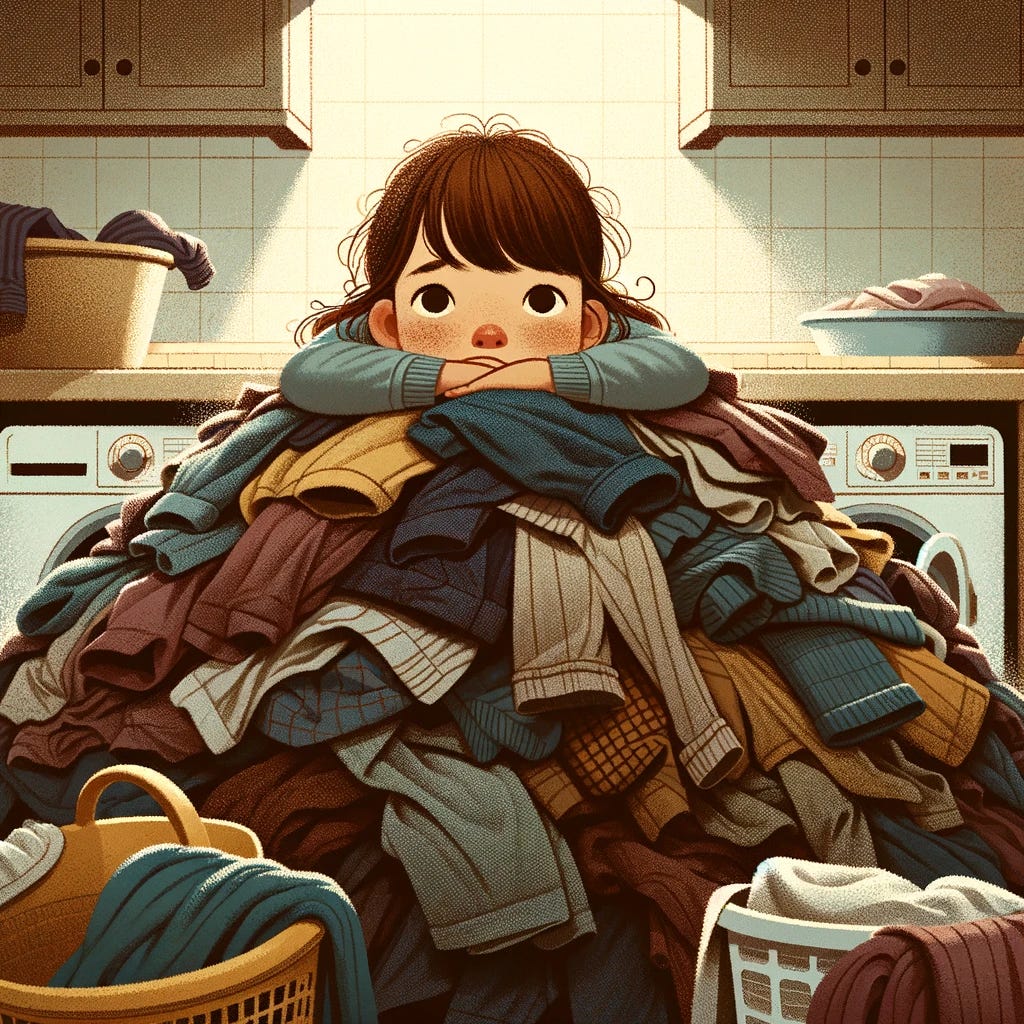
I skidded on my heels. I had no clue where I was going or how to wash clothes, but I learned very quickly that day. My mom filled the bathtub with warm water and lathered shampoo over the dark patch. I folded the shirt in half and furiously rubbed the two sides together until my arms were drowned in suds. I hung it up to dry and proceeded to check on the stain every fifteen minutes–my entire economic future depended on this shirt being clean.
Thankfully, the laundry gods granted me a revitalized white shirt. My piggy bank lived to see another day.
But why did my mom feel the need to torture her grief-stricken seven-year-old? Why was it vital that she did?
Logical Consequences
It all comes back to the concept of logical consequences. The idea is that parents allow their children to experience the real results of their actions, rather than shielding them from the outcomes of their mistake.
For example, say your kid roams the house with a glass cup in hand. They’ve recently invented a new game of hopscotch with your floor’s tile pattern. Water splashes onto the ground as they leap and land on the imaginary board. They wobble on jump eight. A wobble turns into unsteady swaying. They instinctively throw out their arms to stabilize, and the glass plummets to the ground, shattering.
You rush over, terrified that they're hurt. Your heart breathes a sigh of relief as you realize they’re unharmed. But your relief quickly changes to irritation; you’ve told them a million times not to play when they’re holding fragile things. You point sternly at them and exclaim, “Why would you do this?! I’ve told you so many times! Congratulations, you’ve earned a month of garbage duty, young lady!”
Okay, deep breath.
Is giving them trash duty really teaching them the consequences of their actions?
In the real world, if you were to drop an expensive glass at a local store, the shopkeeper wouldn’t run up to you and assign you a month of garbage duty. They would probably point to the “You break it, you buy it” sign taped above the fragile items. You would sheepishly smile and hand them ten dollars before running from the embarrassing scene.
Why not do the same for your kid’s broken glass scenario? You two could walk to the closest Target, and she would hand over five dollars to buy a new cup.
She’ll now be much more careful when she’s handling fragiles; she doesn’t want to have to open her piggy bank again unless it’s to buy unicorn paraphernalia.
You’ve taught her the logical consequences of her actions: break a glass, apologize, and buy a new one. No need for lecturing or condemnations. Everyone makes mistakes. The important thing is to rectify the situation and try not to repeat it in the future.
My world felt like it was about to implode from the cost of dry cleaning. So, I learned how to wash clothes and was much more careful around open beverages from then on.
Most importantly, I learned how to reconcile my mistakes.
Again, there’s nothing wrong with slip-ups as long as you grow from them. Sometimes, you need to show your kids the logical consequences of their actions, even if it means they have to roll up their sleeves and fix their mess.